
Information for teens and young adults
Knowing your rights can help you feel more prepared when you’re at school, at the polls, or interacting with immigration authorities.
These resources are designed to give you basic information about your rights and what you can say or do. They are not legal advice.

You have rights, regardless of your immigration status.
If you encounter U.S. Immigration and Customs Enforcement (ICE), you have rights. Knowing what to say—and what not to say—can help you protect those rights.
What to say
“Am I free to leave?”
If the answer is yes, you can leave calmly. You generally do not have to answer questions about your immigration status, birthplace, or how you entered the United States.
“I am choosing to remain silent.”
You generally have the right to remain silent. You do not have to answer questions about your immigration status or immigration history.
“I do not consent to a search.”
You can clearly state that you do not consent to a search. Do not physically resist if an officer searches you anyway.
“I want to speak with a lawyer.”
If you are detained, you can ask to speak with a lawyer. You have the right to hire a lawyer, but the government does not provide a lawyer for you in immigration proceedings.
“Please show me the warrant.”
If ICE comes to your home, you generally do not have to open the door. You can ask officers to show you a judicial warrant signed by a judge. An ICE administrative warrant generally does not authorize officers to enter your home without your consent.
Remember
- Do not lie about your immigration status or provide false information.
- Do not use or show false documents. You do not have to physically resist an officer to exercise your rights.
- If you are unsure what to do, seek legal help from a qualified immigration attorney or legal-services organization.
Key Phrases
“Am I free to leave?”
“I am choosing to remain silent.”
“I do not consent to a search.”
“Please show me the warrant.”
“I want to speak with a lawyer.”

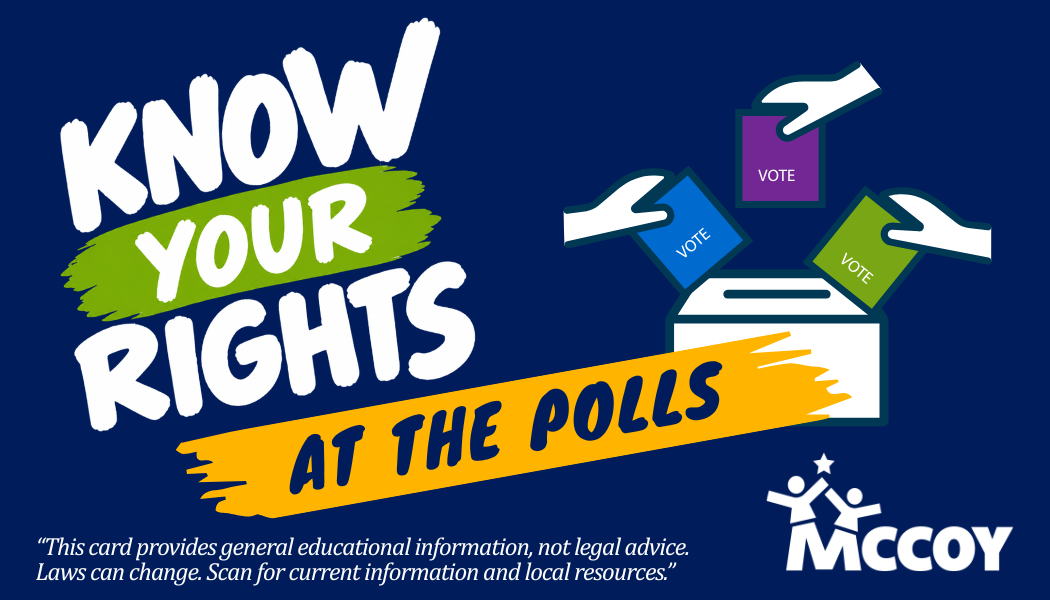
First time voting? You’ve got this!
Voting for the first time can feel like a lot to figure out. You have the right to ask questions, take your time, and cast your ballot privately.
If there’s a problem
1. Check your registration. Make sure you are registered before Election Day.
2. Find your polling place. Visit IndianaVoters.com to find where you vote.
3. Bring your government-issued photo ID.
4. Ask questions. Poll workers can help if you’re unsure what to do.
5. Take your time. Your vote is private. You do not have to tell anyone how you voted.
DON’T LEAVE.
If there is a problem with your eligibility or registration, ask: “Can I cast a provisional ballot?”
A provisional ballot allows you to cast a ballot while the county election board determines whether you are eligible for your vote to be counted.
Know these rights
Keep campaign gear at home.
Avoid clothing, buttons, stickers, or other items promoting a candidate or political party while at the polls.
Ask questions.
Poll workers are there to help you understand the voting process.
If there’s a problem, ask about your options.
You may be able to cast a provisional ballot.
Stay in line.
Polls are open 6 a.m.–6 p.m. If you are in line by 6 p.m., stay in line—you can still vote.
Remember
You have the right to vote privately and to ask for help if you need it.

You have the right to learn in a safe, supportive, and nondiscriminatory environment.
Knowing your rights can help you understand what school staff can do, what happens if you are accused of breaking a rule, and when you can ask for support.
Searches
School staff may search you or your belongings when they have a reasonable basis to do so.
You can ask:
“What are you looking for?”
“Why are you searching me?”
Discipline
If you are accused of breaking a school rule, you have the right to know what you are accused of and an opportunity to explain your side.
You can ask:
“What rule did I break?”
“Can I explain what happened?”
“What are my options if I disagree with this decision?”
Disability
If you have an IEP or 504 Plan, you have rights to accommodations and additional protections at school.
If your accommodations aren’t being provided, talk with a parent or guardian, counselor, case manager, teacher, or another trusted adult who can help you understand your options.
Bullying & harassment
You have the right to report concerns about bullying, discrimination, or harassment.
Tell a trusted adult and document what happened, including dates, messages, or other information that may help explain what happened.
Your education records
You and your parent or guardian have rights related to your education records. Some of these rights transfer to you when you turn 18 or attend a postsecondary school.
What to say
You don’t have to know all the answers. You can ask questions.
“What rule did I break?”
“Can I explain what happened?”
“What are my options if I disagree with this decision?”
“Can I talk to my parent, guardian, counselor, or another trusted adult?”
Remember
Asking questions is part of knowing your rights.
If you aren’t sure what your rights are in a specific situation, talk with a trusted adult or qualified professional who can help.